Marlborough vs Stowe 2026: an honest head-to-head from UK boarding advisors

Marlborough College and Stowe School are both co-educational UK boarding schools on country estates, but the lived experience, academic identity, and family culture are different. Here's how they actually compare in 2026.
After Eton, Harrow, Westminster and Charterhouse, the next layer of UK boarding regularly comes down to Marlborough College and Stowe School. Both are co-educational, both are predominantly boarding, both occupy historic country estates in the southern English countryside, and both place graduates to Oxford, Cambridge, Imperial and top international universities. Both went co-educational decades ago — Marlborough in 1989 (fully co-ed since), Stowe in 1989 (sixth form) and 2003 (fully co-ed). Both have alumni networks that change what graduates can access throughout their careers.
We advise families considering both schools every admissions cycle, and the differences matter. Marlborough sits in a working Wiltshire market town with the school spread through and around it; Stowe sits in a Grade I-listed 18th-century country house in Buckinghamshire surrounded by 750 acres of National Trust gardens. Marlborough's cultural identity is built around traditional UK boarding rigour with a strong arts and humanities reputation; Stowe's identity is built around the country-house estate, performing arts, and a slightly more relaxed academic register.
Read top to bottom if you're early in the process. Skip to relevant sections if you're choosing between offers. Both schools are exceptional; the right fit depends on specific traits in your child and family.
The 60-second comparison
Marlborough College sits in the market town of Marlborough, Wiltshire — about 90 minutes west of London by train (Pewsey or Hungerford station, then taxi). Founded in 1843, the school has been fully co-educational since 1989. About 970 pupils aged 13-18, predominantly boarding (~80%). The school runs A-Levels alongside Pre-U options. Verified 2025-26 fees (inclusive of VAT): full boarding GBP 61,809 per annum (£20,603 per term), day GBP 49,449 per annum (£16,483 per term). HMC member and Rugby Group school. Alumni include HRH The Princess of Wales.
Stowe School sits in Stowe House — a Grade I-listed early-18th-century country house designed by Sir John Vanbrugh — on a 750-acre estate of National Trust gardens by Capability Brown, in Buckinghamshire about 90 minutes north-west of London. Founded in 1923, much later than most HMC peer schools. About 870 pupils aged 13-18, fully co-educational, predominantly boarding. The school runs A-Levels alongside Pre-U options and the EPQ. Estimated 2025-26 fees in the range of GBP 55,000-80,000 depending on day vs full boarding (school doesn't publish single headline figures across both modes; ask admissions for specific current schedule). HMC member and Rugby Group school.
On paper similar — both ~900 pupils, both co-ed, both rural country estates, both A-Level + Pre-U. The lived experience is genuinely different.
Campus and culture: working town vs Vanbrugh country house
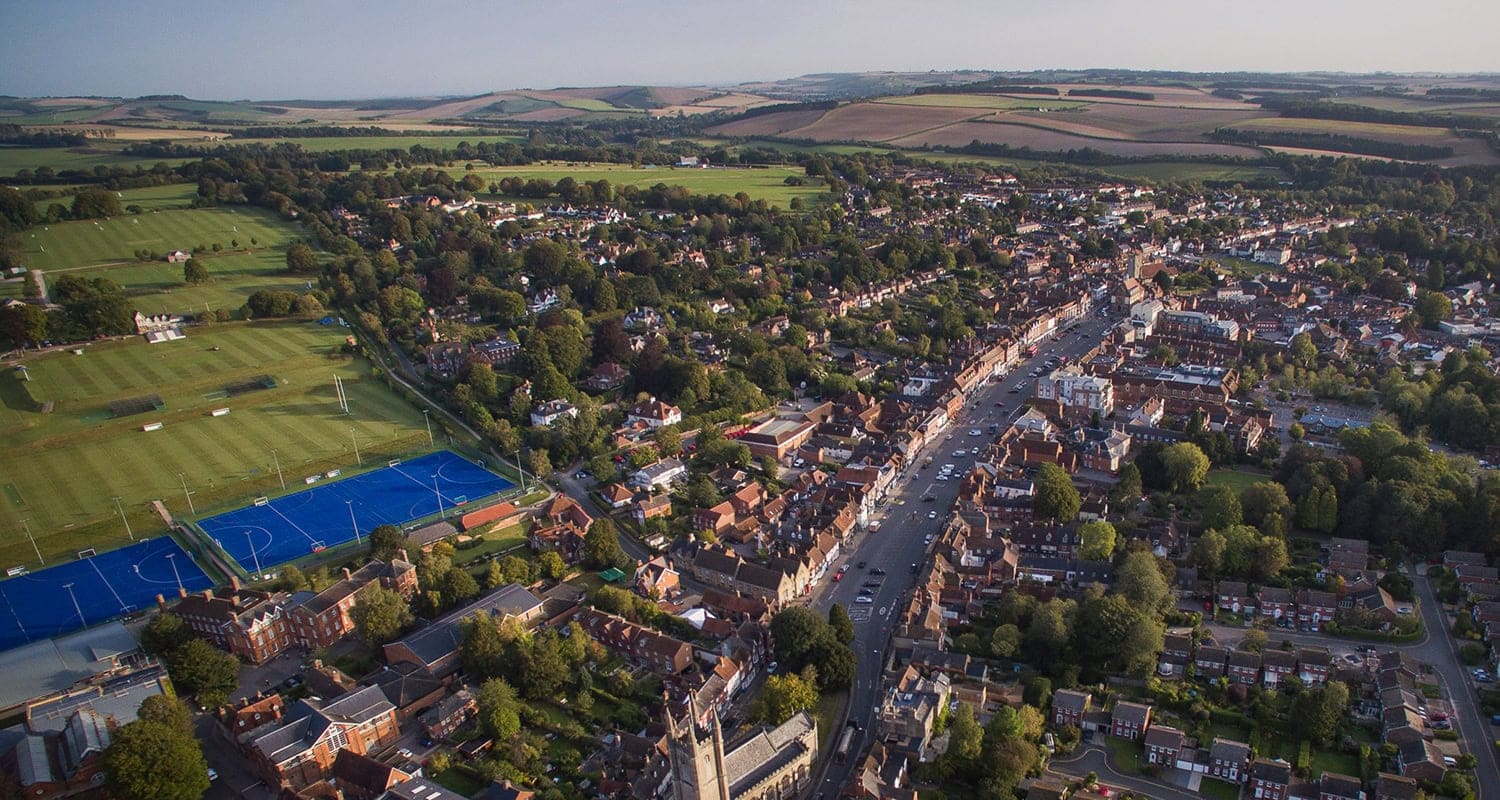
Marlborough's campus is unusual in that the school is spread through and around a working market town. The town of Marlborough has a population of about 8,300; the school adds another ~970 pupils and several hundred staff to the local economy. School buildings, boarding houses, sports facilities and the Marlborough College Chapel are distributed across the town and its surroundings rather than concentrated on a single contained estate. Pupils walk between lessons, meals and boarding houses through what is effectively a small Wiltshire town — pubs, shops, market square and all. This shapes the cultural atmosphere: Marlborough pupils are integrated with a working English town in a way that pupils at most other UK boarding schools aren't.
Stowe's campus is the opposite shape — concentrated within and around Stowe House and its formal landscape gardens. The house itself is one of the most important Grade I-listed country houses in England, designed by Vanbrugh and added to over the 18th century by many of the great English architects. The gardens (Capability Brown's earliest major commission) are owned by the National Trust and form a 750-acre setting for the school. Pupils live and learn within an extraordinary architectural and landscape inheritance; the daily walk between buildings crosses formal lawns, temples and lakes. This shapes culture differently: Stowe pupils develop a deep aesthetic relationship with the country-house tradition and a quieter, more contained social atmosphere than Marlborough's.
A useful filter: Marlborough operates as a school integrated with a working English town — pupils have natural daily exposure to local English life and a slightly busier social texture. Stowe operates as a self-contained country-house estate — pupils have an extraordinary architectural and landscape inheritance and a quieter, more focused daily rhythm. Neither is better; they shape adolescents differently.
Academics: A-Level + Pre-U, slightly different identities
Both schools follow the British system: pupils arrive at age 13, do GCSEs in the Fifth Form (Year 11), pick three to four A-Level or Pre-U subjects in the Lower Sixth and sit final exams at the end of the Upper Sixth (Year 13). Both schools offer the Pre-U as an alternative to A-Level in select subjects and the EPQ (Extended Project Qualification) for independent research. Neither runs the IB Diploma — if IB is essential to your university targets, neither Marlborough nor Stowe is the right shortlist.
Marlborough's academic identity is built on a balance of rigour and breadth. The school has historically been strong across humanities, sciences and modern languages, with particular reputational depth in art, design and history. The Marlborough College Mound, the Norwood Hall library, and the school's Mathematics and Sciences departments all carry strong reputations. Sixth-form cohort sizes are typical of top-tier UK boarding (10-15 in most A-Level subjects, smaller for niche subjects). The school's IB equivalence question is whether the breadth and depth feel right — and for most international families targeting UK universities via A-Level, the answer is yes.
Stowe's academic identity is somewhat more arts-and-character-orientated. The school produces strong A-Level and Pre-U results across the board but has a particular cultural emphasis on music, drama, art and design — the Stowe Theatre is a genuinely impressive performing-arts facility, the music school is well-resourced, and creative arts feature prominently in the senior leadership team's stated priorities. Academic rigour is strong but Stowe is more comfortable than Marlborough in saying that the school's identity is not narrowly academic. Sixth-form cohort sizes are similar to Marlborough's.
Practical filter: if your child is strongly academically driven and wants a school where academic identity is the primary axis, Marlborough's reputation tilts that way slightly more. If your child has strong creative-arts interests alongside solid academics — particularly music, drama or visual arts — Stowe's environment may resonate more.
Boarding house life
Marlborough has about 16 boarding houses, with most pupils in fully-boarding houses (a small number of day houses serve local families). Houses hold roughly 50-60 pupils each, mixed across all year groups, with housemasters or housemistresses living in the house. Marlborough's boarding houses are scattered through and around the town, which means pupils walk between their house and the main school day buildings; this is part of the school's distinctive structural identity.
Stowe has about 12 boarding houses, similarly mixed across year groups, with housemasters and housemistresses living in. Stowe houses are clustered closer to the central Stowe House and the dining hall, so pupils' daily geography is more concentrated than Marlborough's. Stowe's boarding culture is described by families and pupils as warmer and more relaxed than some traditional UK boarding schools — the smaller scale (870 pupils vs Marlborough's 970) and the more contained estate contribute to this.
Practical filter: if you want your child in a tighter, more contained boarding environment with a strong house identity but a relaxed feel, Stowe's structure may be the better fit. If you want a boarding environment with more day-to-day movement through a working English town and slightly larger overall scale, Marlborough's structure is the better fit.
Cost and financial aid
Marlborough has published verified 2025-26 fees (inclusive of VAT): full boarding GBP 61,809 per annum (£20,603 per term), day GBP 49,449 per annum (£16,483 per term). These are the published numbers — bursar's office can confirm current schedule for 2026-27. Stowe's published 2025-26 fees are not as transparently published as Marlborough's; estimates from the market position the school in a similar range (~£55-72k full boarding, ~£45-55k day). Both schools add roughly GBP 4,000-7,000 annually for exam fees, books, uniforms, kit and extras; GBP 5,000-8,000 for travel home for international families; GBP 3,000-5,000 for personal spending. All-in for an international family typically lands at GBP 75,000-90,000 (USD 95,000-115,000) per year at either school.
Marlborough's bursary and scholarship programme includes academic, music, art, drama, sport and all-rounder awards, alongside need-based bursaries. Awards typically cover 10-50% of fees with the option of need-based additional support for families demonstrating financial need. International families are eligible but the bursary pipeline is smaller than the UK-applicant pool.
Stowe's bursary and scholarship structure is similar — Foundation Scholarships across academic, music, art, drama and sport, plus need-based bursaries on top. Awards typically cover 10-50% of fees with need-based extensions. Similar international eligibility caveat to Marlborough.
Admissions: what each school weights
Both schools use the standard UK boarding admissions cycle: register early (age 10-11, some 3-4 years before entry), sit the ISEB Common Pre-Test in Year 6, attend visits and interviews in Year 7, and complete the Common Entrance examination or the school's own paper in Year 8. Sixth form (16+) entry has a separate cycle with assessment and interview in autumn of Year 11.
Marlborough is academically selective at the top end of co-ed UK boarding — typical admitted pupils are strong but not the very narrow academic-elite cohort that Westminster or Eton draw. The school looks for academically capable pupils who will engage fully with the co-curricular life (sport, music, art, drama). The interview is central; Marlborough's admissions team is good at identifying pupils who will thrive in the spread-out, town-integrated structure.
Stowe's admissions philosophy is similar but tends to weight character and creative engagement slightly more than pure academic record. The school is academically selective but consciously avoids the narrowest academic-only admissions filter. Stowe's interview process surfaces creative-arts and broader extracurricular strengths alongside academic performance. Strong fit for genuinely all-round pupils whose strengths include creative arts or performance.
Practical timing: register at both schools by age 10-11. Sixth form entry is the second prime entry point and typically easier than Year 9 at both schools.
University placement
Headline university outcomes are strong at both schools. Marlborough places consistently to Oxford and Cambridge, with significant flow into top Russell Group universities (Imperial, LSE, UCL, Durham, Edinburgh, St Andrews, Bristol, Warwick), substantial US Ivy + selective placement, and growing European and Hong Kong / Singapore presence. Marlborough's combination of A-Level + Pre-U + EPQ gives strong applications across both UK and US university models.
Stowe's university placement is similar at the top, with Oxford, Cambridge, Imperial and Russell Group as the consistent destinations, plus significant US matriculation. Stowe's creative-arts strength translates into a slightly stronger pipeline into music conservatoires (Royal College of Music, Royal Academy of Music), art schools (Central Saint Martins, RCA), and creative-arts university courses; this is a meaningful differentiator for families targeting creative careers.
Both schools have well-resourced university counselling offices with international experience. Either school's counselling team will work effectively with a Türkiye-based family on US, UK and European university applications.
Day-to-day: working town vs landscape garden
Marlborough's daily rhythm involves natural movement through and around a working English town. Pupils walk through the High Street, past the market square, between buildings that are part of the town's working fabric. The town has shops, cafés, pubs and the Marlborough Town Council; school life is woven into local civic life in a way that other UK boarding schools' isn't. Weekends include local town walks, supervised trips to Swindon or Salisbury, and Sunday programming on campus.
Stowe's daily rhythm is quieter. Pupils walk between Stowe House and surrounding teaching, sports and arts buildings through formal lawns, past Vanbrugh's temples, and across landscape gardens that are also a National Trust visitor attraction. Weekends include house events, sports fixtures on the school's own grounds, supervised trips into Buckingham or Oxford (about an hour away), and Sunday programming centred on the estate. The country-house estate is the world; pupils develop deep familiarity with one extraordinary place.
Practical filter: Marlborough shapes adolescents who are comfortable in working English town life, who develop natural social fluency in a busier daily environment, and who value mixed civic-school texture. Stowe shapes adolescents who develop deep aesthetic appreciation, who thrive in a quieter and more contained daily rhythm, and who value the estate as a defining sense of place.
Who Marlborough is the right call for
We typically recommend Marlborough when the family values academic rigour balanced with strong sport and creative programmes, when the child is genuinely all-round (strong academically with meaningful extracurricular interests), and when the family wants the school to be integrated with a working English town rather than isolated on an estate. Strong fit for families who want their child to develop natural English social fluency through daily contact with a real town, for academically capable pupils targeting Oxford, Cambridge, Imperial and top Russell Group universities, and for families comfortable with the school's traditional public-school rhythm.
Less of a fit for children who would feel overwhelmed by the spread-out town structure, who prefer a more contained boarding environment, or who specifically want the country-house architectural and landscape inheritance that Stowe provides.
Who Stowe is the right call for
We recommend Stowe when the family values the Vanbrugh country-house and Capability Brown landscape inheritance, when the child has meaningful creative-arts interests (music, drama, visual arts) alongside solid academics, and when the family wants a slightly more relaxed academic register without compromising on top university placement. Strong fit for international families wanting their child to live and learn within an extraordinary architectural and landscape setting, for arts-strong pupils targeting music conservatoires or creative-arts university pathways, and for adolescents who would benefit from a tighter, more contained boarding environment.
Less of a fit for purely academic pupils who would prefer a narrower academic identity (Westminster or Marlborough fits that better), for children who would feel constrained by the country-house isolation, or for families specifically wanting the IB Diploma credential.
The advisor's take
Both schools are exceptional UK co-ed boarding options at a similar price point. The mistake families make is treating them as interchangeable — they aren't. If we had to compress our advice into one sentence: choose Marlborough if you want your child in a school integrated with a working English town with strong academic rigour and all-round development; choose Stowe if you want your child living and learning within an extraordinary country-house estate with creative-arts strength alongside solid academics.
If neither captures it, the next layer of UK co-ed boarding — Wellington College (Berkshire, very large, IB option), Oundle (Northamptonshire, ancient, engineering-strong), Brighton College (Sussex coast, IB option, Sunday Times School of the Decade) — solves different problems. We are happy to talk through that. Our advisor Kevin from London handles UK boarding placements and has deep current intel on Year 9 and 16+ availability at all of these schools for September 2026 and 2027 entry.
Frequently asked questions
- Marlborough or Stowe — which is more academic?
- Marlborough has the marginally stronger academic-identity reputation, but the gap is small. Both schools place consistently to Oxford, Cambridge and top Russell Group universities. Stowe is comfortable with a slightly broader academic register that includes strong creative-arts weighting. If your child is strongly academically driven without a major creative-arts component, Marlborough is the marginal better fit; if creative arts matter alongside academics, Stowe.
- Does either school offer the IB Diploma?
- No — neither Marlborough nor Stowe offers the IB Diploma. Both run A-Level alongside Pre-U options and the EPQ for independent research. If the IB Diploma is essential to your university targets, you'll need to look at IB-offering UK boarding alternatives like Wellington College, Charterhouse, Brighton College or Sevenoaks.
- How does the cost compare?
- Marlborough's verified 2025-26 fees are GBP 61,809 per annum for full boarding (inclusive of VAT) and GBP 49,449 for day. Stowe's published fees are less transparent but estimated in the GBP 55,000-72,000 range for full boarding. All-in annual cost for international families (with travel, extras, personal spending) typically lands at GBP 75,000-90,000 (USD 95,000-115,000) at either school.
- Which school is better for creative arts?
- Stowe has the stronger published creative-arts identity — particularly music, drama and visual arts, with a well-resourced theatre and music school, and a clear leadership emphasis on creative arts as part of the school's identity. Marlborough has strong arts provision too (notably art and design) but creative arts are not the defining axis of the school's identity in the way they are at Stowe.
- Is the Princess of Wales connection real?
- Yes — HRH The Princess of Wales (Catherine, formerly Kate Middleton) attended Marlborough College, leaving in 2000. This is part of the school's contemporary cultural identity. Stowe does not have an equivalently widely-known recent royal alumna or alumnus.
- How does the campus environment feel different?
- Marlborough is integrated with a working English market town — pupils walk through the town between buildings and have natural daily contact with local English life. Stowe is contained within a Grade I-listed Vanbrugh country house surrounded by 750 acres of National Trust gardens — pupils live within an extraordinary architectural and landscape setting that's essentially a stately home. The daily texture is very different at the two schools.
- Which school is easier to get into?
- Both schools are selective at top-tier UK boarding standards. Marlborough has marginally stronger academic-record weighting; Stowe weights character and creative engagement slightly more heavily. If your child is academically polished, Marlborough's odds are slightly better; if creative-arts strong and well-rounded, Stowe's odds are slightly better. For Year 9 entry, register by age 10-11; for 16+ entry, register in summer/autumn of Year 11.
- How accessible are the schools from London?
- Both are about 90 minutes from central London. Marlborough is in Wiltshire — train to Pewsey or Hungerford station, then 10-15 minute taxi. Stowe is in Buckinghamshire — train to Bicester or Milton Keynes, then 20-30 minute taxi, or direct drive from M40. Both are accessible for parent visits and term-end pickups but neither has a London station immediately on-site.
See how this article maps to your child's profile.
Run our 5-step AI Match — we'll factor in the trade-offs covered above.
Start AI MatchTalk to a senior education advisor.
AI helps you shortlist. Our advisors help your family decide — with a decade of admissions experience across UK, Switzerland, North America and Asia.