Eton vs Harrow 2026: an honest head-to-head from UK boarding advisors
Eton College and Harrow School are the two most-cited boys' boarding schools in the world. Here's how they actually differ on culture, curriculum, cost, and who each one is right for in 2026.
Most UK boarding-school conversations in our practice eventually arrive at the same two names: Eton College and Harrow School. The two schools sit about 25 kilometres apart across north-west London, have been compared and contrasted for nearly six centuries, and remain — for international families considering a single-sex boys' boarding education in England — the canonical shortlist. Both produce prime ministers (Eton seven of the last twenty UK PMs, Harrow two). Both maintain global alumni networks that change what graduates can access in their twenties. Both are unmistakably different schools.
We advise international families considering both schools every admissions cycle. The information on the open market is uneven: rankings flatter, marketing is sober, the visit experience at both is impressive. What's harder to find is an honest comparison of what daily life and academic culture actually look like at each, and which child is likely to thrive at which. This is our attempt at that comparison — written with the same trade-offs we walk families through privately.
Read top to bottom if you're early in the process. Skip to relevant sections if you're choosing between offers. The differences compound, and the right answer for your family is rarely either school's headline pitch.
The 60-second comparison
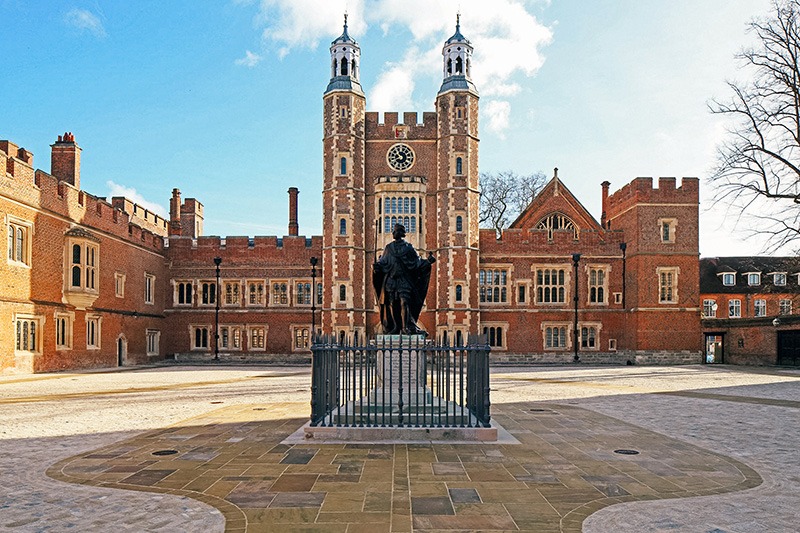
Eton College sits in the Royal Borough of Windsor and Maidenhead, beside Windsor Castle, on a 400-acre campus. Founded in 1440 by King Henry VI, it is the older and larger of the two. About 1,340 boys (no girls), all boarders, 13–18 years old, with a 1:8 student-to-teacher ratio, average class size 15. The school teaches IGCSE and A-Level, with a meaningful pre-IB pilot in development. Tuition + boarding for 2025–26 is approximately GBP 60,000 (USD 76,000). Selective at the level of 'Highly Selective' rather than 'Elite' — admissions is rigorous but not the bottleneck many believe.
Harrow School sits in north-west London (Harrow-on-the-Hill), on a 300-acre campus with the City of London visible from its hill on clear days. Founded in 1572 by John Lyon. About 830 boys (no girls), all boarders, 13–18 years old, 1:8 ratio, class size around 14. IGCSE and A-Level, with a pre-A-Level Lower Sixth option and a Pre-U track for a few subjects. Tuition + boarding for 2025–26 is approximately GBP 58,000 (USD 74,000).
On paper the schools look similar. The lived experience — campus, social culture, academic identity — is fundamentally different.
Campus and culture: Windsor vs Harrow-on-the-Hill
Eton's campus is unusual. The school is integrated into the town of Eton in a way that no other British boarding school is — there is no perimeter wall, the school's 25 boarding houses are scattered along the high street and side roads, and boys walk between classes, meals, sport and chapel through what is effectively a working medieval village. Windsor Castle is across the river bridge, a 10-minute walk away. This open structure shapes the social atmosphere: boys have unusual day-to-day independence by British boarding standards, with house masters trusted to manage the cohort largely without barriers. The cohort is unmistakably international (40+ nationalities) but the social tone is unmistakably traditional English.
Harrow's campus is the opposite shape — concentrated on a hill above north-west London, with the boarding houses (twelve of them) clustered tightly around the school's central buildings, chapel and sports fields. The footprint is smaller, the social atmosphere more contained. Harrow boys live more closely with each other than Eton boys do; the house identity is unusually strong. Mid-19th-century Harrow culture (the songs, the boater hats, the historic strictness) is preserved more visibly than at most modern British boarding schools — some families find this charming, some find it dated. Internationals make up about 30% of the school.
A useful filter: Eton operates like a small university — independent, scattered, English-traditional but globally textured. Harrow operates like a strong house community — close-knit, hilltop, more visibly bound to tradition. Neither is better; they shape boys differently.
Academics: similar structure, different identity
Both schools follow the British system. Boys arrive at age 13, do IGCSEs in the Fifth Form (Year 11), pick three to four A-Level subjects in the Lower Sixth and sit final A-Levels at the end of the Upper Sixth (Year 13). The curriculum, exam boards and assessment regimes are similar; the actual differences lie in teaching philosophy and depth of provision.
Eton's academic identity is built on small-group tutorials. Every boy is assigned a personal tutor (called a 'Tutor' or 'mtutor', distinct from the house master) — an academic specialist who oversees the boy's whole intellectual development across subjects, including reading lists outside the curriculum. Eton's College Library is genuinely the equivalent of a small university library, and senior boys present to it as a matter of course. The school has a long tradition of producing humanities-focused public-facing graduates (politicians, diplomats, writers) and a recently strengthened STEM and biomedical programme. A-Level cohort sizes are typically 10-15 in popular subjects, 5-10 in less popular ones.
Harrow's academic identity is built more around the curriculum's edges. The school has unusually strong Pre-U courses in a small set of subjects (the Pre-U is the more rigorous successor to A-Level offered by Cambridge Assessment), genuinely outstanding mathematics and physics departments, and the Lyon Centre — a research-orientated programme for senior boys engaging in independent projects with university mentors. The cohort sizes are similar to Eton's at A-Level. Harrow's stronger reputation is for producing boys who go on to top engineering, finance and law careers — partly cultural, partly because the Pre-U positioning attracts mathematically-strong students.
Practical filter: if your son is humanities-curious, debate-inclined and you want him in an environment where the academic conversation extends beyond the syllabus, Eton's tutorial structure is unusually well-fitted. If your son is mathematically or scientifically focused and benefits from deeper specialisation, Harrow's Pre-U and Lyon Centre provision is meaningful.
Boarding house life
Eton has 25 boarding houses, each headed by a 'House Master' (or House Mistress, increasingly common since the early 2010s). Each house has 50 boys spread across Years 9-13. Every boy has his own study-bedroom from the start — a striking feature for a British boarding school and a deliberate part of the school's culture around independence. The house master and the dame (a female pastoral lead in each house) live in the house and are central to the boy's experience. House identity is strong but Eton boys mix more across houses than Harrow boys do.
Harrow has twelve houses, similarly headed by housemasters. Each house holds 70-75 boys (larger than Eton houses). New boys (Year 9, called 'Shells') share a four-bed dorm room initially before earning a single room in later years. The house competition (sports, debating, music, drama) is unusually intense at Harrow — house identity is a stronger thread of the social experience than at Eton. Boys often describe their house as their primary social unit, more so than their year group.
Practical filter: if you want a boarding environment where your son has private space and significant individual independence, Eton's structure is closer. If you want a tighter house identity and a more communal early-years experience, Harrow's structure is closer.
Cost and financial aid
Both schools publish similar fees for 2025–26: Eton at approximately GBP 60,000 and Harrow at approximately GBP 58,000 for full boarding. The published figures cover tuition, boarding, meals and most curricular costs. Add GBP 4,000-6,000 annually for exam fees, books, uniforms (both schools have specific outfitters with multi-week lead times) and house contributions; GBP 5,000-8,000 for travel home (Turkish families: 4 round trips Istanbul-London annually); GBP 3,000-5,000 for personal spending, music lessons and trips. All-in for an international family typically lands at GBP 75,000-85,000 (USD 95,000-108,000) per year.
Eton has historically funded need-based bursaries through its King's Scholarship and Junior Scholarship programmes. Awards have grown substantially since 2015; the school has committed to making bursary support available for up to 25% of pupils by the end of the decade. Bursaries cover up to 100% of fees for the highest-need families. The application process for these is competitive and document-intensive — start the moment you submit the main application.
Harrow's bursary provision is meaningful but smaller than Eton's in absolute terms. The school offers a range of academic, music and all-rounder awards through its scholarship programme and need-based bursaries on top. Awards typically cover 10-50% of fees, with full-fee bursaries reserved for highest-need families. Realistic for genuinely high-need international families but less programmatic than Eton's pipeline.
Admissions: what each school weights
Both schools admit around 25-30% of applicants in a typical year for Year 9 entry, with the applicant pools being heavily self-selecting. The published admission timelines are similar: registration ideally takes place by age 10-11 (some 4 years out from the actual entry date), with the Common Entrance examination or equivalent assessment in May of Year 8, and an interview process during Year 7 and Year 8.
Eton uses its own admissions assessment (ISEB Common Pre-Test and the school's own further tests and interviews) and weights interviews heavily. The school is famously good at identifying boys who are bright but not yet polished — Eton's admissions team is not looking for the most over-prepared applicant, they're looking for genuine intellectual curiosity, character, and the ability to thrive in an open-structure environment. Boys who interview well at Eton are typically articulate, naturally curious, and comfortable with adults.
Harrow uses similar testing but is more conventional in what it weights. The interview is still central, but academic record carries marginally more weight. Harrow's admissions team is looking for boys who will thrive in the tighter house structure and engage with the school's specific traditions. Stronger fit for academically polished applicants who are also character-strong; less of a fit for boys whose strength is intellectual curiosity over conventional academic excellence.
Practical timing: register by age 10-11 for either school. The application process for international families is genuinely 24-36 months long, with milestones at age 11 (registration), age 12 (school visits and interview prep), age 13 (assessments and interview).
University placement
Headline university outcomes are similar at the top end: both schools place 20-25% of boys at Oxbridge in a typical year, with most other graduates landing at top UK universities (Imperial, LSE, UCL, Bristol, Durham, Edinburgh) and substantial flows into US Ivies, MIT and Stanford. Both have excellent university counselling offices with deep relationships at admissions offices internationally.
Eton's destination mix favours humanities-strong universities — there is consistent flow to Oxford English, History, Classics and PPE — alongside genuinely strong STEM placement and growing US university representation. The school's PPE pipeline is particularly notable.
Harrow's mix tilts toward STEM-heavy universities — Cambridge Engineering, Imperial, MIT, ETH Zurich — alongside strong placement into Oxford and the major UK universities. The Pre-U strength in mathematics and the Lyon Centre research feed into this. Both schools have strong international university presence too, including US Ivies and the European top tier.
Day-to-day: traditions and weekend culture
Eton's daily rhythm includes elements that families either find charming or anachronistic: the morning chapel, the formal academic dress, the prefects (called 'Captains of the School', 'Captain of the Oppidans' etc.). The school's central traditions are visible but not enforced as performance — the school has consciously modernised its approach in the last decade, while retaining the structural framework. Weekends are well-resourced, with sport on Saturdays, optional Sunday programming, and easy access to Windsor and London by train.
Harrow's traditions are more visibly performative. The 'speech rooms' (formal weekly assemblies), the school songs (sung in chapel and at house events), the boater hats and tailcoats on Sundays — these are part of the boys' daily and weekly experience in a way they aren't at Eton. The town of Harrow-on-the-Hill is village-like and quiet; central London is 25 minutes by train. Weekends often centre on house events and sport on the hill itself.
Practical filter: Eton's tradition is structural; Harrow's tradition is more performative. Some boys love performative tradition; others find it limiting. Be honest about your son's temperament.
Who Eton is the right call for
We typically recommend Eton when the family values academic depth combined with significant individual independence, when the boy is intellectually curious and would benefit from a tutorial system that extends beyond the syllabus, and when the family is comfortable with the open campus structure where boys have unusual day-to-day freedom by British boarding standards. Strong fit for boys aiming at Oxford humanities, US Ivies, and PPE-style careers.
Less of a fit for boys who would feel adrift without tighter structure, who prefer a smaller cohort and stronger house identity, or whose academic strength is more in the conventional polished-student mould than in genuine intellectual curiosity.
Who Harrow is the right call for
We recommend Harrow when the family values a tighter house community, when the boy is mathematically or scientifically strong and would benefit from Pre-U provision and the Lyon Centre, when the family appreciates visible tradition as part of the schooling experience, and when the smaller boarding numbers feel right. Strong fit for boys aiming at engineering, mathematics, applied sciences and finance careers.
Less of a fit for boys who would feel constrained by the more performative traditions, who would do better in a school where house identity is less central, or who would thrive in the more humanities-leaning environment of Eton.
The advisor's take
Both schools are exceptional. The mistake families make is treating them as interchangeable — they aren't. If we had to compress our advice into one sentence: choose Eton if you want your son to encounter a wide world with significant freedom to explore it; choose Harrow if you want your son to develop a tight community identity and a sharper academic focus. Most families know which one resonates within an hour of asking the question out loud.
If neither captures it, both schools may be the wrong shortlist. The next layer of UK boys' boarding — Winchester College, Charterhouse, Wellington College, Westminster (day/boarding mix), Marlborough — solves problems Eton and Harrow don't, often with different cultures and fee profiles. We are happy to talk through that.
Frequently asked questions
- Is Eton or Harrow harder to get into?
- Both schools admit roughly 25-30% of applicants in a typical year for Year 9 entry. The applicant pools are highly self-selecting. Eton has a marginally larger entry cohort and a slightly more flexible interview style; Harrow weights academic record slightly more heavily. Strong candidates often apply to both.
- When should I register my son?
- Register by age 10-11 for either Eton or Harrow — that is roughly 4 years before the Year 9 entry date. The actual assessment process happens in Years 7-8 (ages 11-13), but both schools fill registration well before that. For international families targeting Year 9 entry in September 2027, the registration window is closing now.
- How much do Eton and Harrow cost in 2026?
- Eton's full-boarding fee for 2025-26 is approximately GBP 60,000 (USD 76,000); Harrow at approximately GBP 58,000 (USD 74,000). All-in for an international family typically lands at GBP 75,000-85,000 (USD 95,000-108,000) per year — including travel home, extras, and personal spending. Both schools update fees annually.
- Do Eton and Harrow offer bursaries?
- Both schools offer needs-based bursaries. Eton has historically funded a substantial bursary programme — including full-fee bursaries for highest-need families — and has publicly committed to expanding it. Harrow's bursary provision is meaningful but smaller in absolute terms. Realistic for genuinely high-need families at both schools, with Eton's pipeline being more programmatic.
- What is the difference between the boarding houses at Eton and Harrow?
- Eton has 25 houses, each with 50 boys spread across Year 9-13. Every boy has his own room from the start. Harrow has 12 larger houses with 70-75 boys each; new boys share a four-bed dorm initially before earning a single room. House identity at Harrow is unusually strong; at Eton, boys mix more across houses.
- Are Eton and Harrow co-educational?
- No. Both Eton and Harrow are single-sex boys' boarding schools. They remain among the few UK boarding schools that have retained this structure. If your family is looking at the major co-educational alternatives, consider Rugby, Marlborough, Wellington and Charterhouse (which moved to co-ed in 2021).
- Which school is better for STEM versus humanities?
- Eton has the slightly stronger humanities reputation — particularly for boys aiming at Oxford English, History, Classics and PPE. Harrow has the slightly stronger STEM reputation, with Pre-U mathematics, the Lyon Centre research programme and a long track record of engineering and applied science placements. Both schools are strong across both areas; the difference is at the margin.
- What does daily life look like at each school?
- Eton boys walk between classes, meals and sport through the integrated village of Eton, with significant day-to-day independence. Harrow boys live in a more concentrated campus on Harrow-on-the-Hill, with stronger house identity and more visible traditions (boater hats, school songs, tailcoats on Sundays). Both have similar academic schedules and excellent sport and music provision.
- What university outcomes do Eton and Harrow produce?
- Both schools place 20-25% of boys at Oxbridge in a typical year, with strong flows into Imperial, LSE, UCL, Bristol, Durham and Edinburgh, plus growing US Ivy and MIT representation. Eton's destination mix leans toward Oxford humanities and PPE; Harrow's leans toward Cambridge Engineering, Imperial and MIT.
- How should I shortlist between Eton, Harrow and other UK boarding schools?
- We usually start with three filters: single-sex vs co-ed preference, academic identity (humanities-curious vs STEM-focused) and house culture (tighter community vs more independence). For boys looking at single-sex boys' boarding specifically, Eton and Harrow are typically two of three or four schools considered (along with Winchester and possibly Westminster). Our AI Match or a 30-minute advisor call walks through this in detail.
See how this article maps to your child's profile.
Run our 5-step AI Match — we'll factor in the trade-offs covered above.
Start AI MatchTalk to a senior education advisor.
AI helps you shortlist. Our advisors help your family decide — with a decade of admissions experience across UK, Switzerland, North America and Asia.