Brighton College vs Wellington College 2026: an honest head-to-head from UK boarding advisors
Brighton College and Wellington College are two of the most-cited co-educational UK boarding schools, both offering IB alongside A-Level. Here's how they actually differ on campus, cohort, curriculum, cost, and who each one is right for in 2026.
Once families have weighed the very top UK boarding tier (Eton, Harrow, Westminster, Charterhouse) and decided to look at the most ambitious large-scale co-educational alternatives, the conversation typically narrows to two names: Brighton College and Wellington College. Both are HMC schools. Both are fully co-educational. Both run A-Level alongside the IB Diploma. Both have published 2025-26 fees that put them in the same financial bracket. And both have, in their own ways, become reference points for what ambitious modern UK boarding can look like — Brighton named The Sunday Times 'School of the Decade' for academic results in 2024, Wellington founded by Queen Victoria in 1859 as a national memorial to the 1st Duke of Wellington and now one of the largest IB Diploma cohorts in the UK.
We advise families considering both schools every admissions cycle. The differences are real and the decision matters. Brighton sits in central Brighton on the Sussex coast — an urban day school with boarding option that has the highest Oxbridge offer rate of any UK independent school in recent years. Wellington sits on a 400-acre Berkshire estate near Sandhurst — a country boarding school that became the largest IB Diploma cohort in the UK by deliberate strategic choice over the last fifteen years. Same fee range, fundamentally different cultures.
Read top to bottom if you're early in the process. Skip to relevant sections if you're choosing between offers. Both schools are exceptional; the right fit depends on whether your child fits the urban-coastal versus rural-estate environment, and on which credential pathway you want.
The 60-second comparison
Brighton College sits in central Brighton on the East Sussex coast, about 90 minutes from London by train. Founded in 1845. About 1,450 pupils across Pre-Prep (ages 3-7), Prep (7-13) and Senior (13-18) schools, fully co-educational. The Senior School has boarding option from age 13 but is predominantly day. Both A-Level and IB Diploma at sixth form. Named The Sunday Times 'School of the Decade' for academic results in 2024, with one of the highest pupil offer rates to Oxford and Cambridge of any UK independent school. Verified 2025-26 termly fees for Year 9 (4th Form, inclusive of VAT): £10,470 day / £15,290 weekly boarding / £18,130 full boarding; Senior years rise proportionally with full boarding at Sixth Form around £19-20k per term. Annualised: ~£31k day, ~£46k weekly boarding, ~£54-60k full boarding at top years. HMC member.
Wellington College sits in Crowthorne, Berkshire, on a 400-acre estate close to Sandhurst military academy, about 70 minutes from central London by train. Founded in 1859 by Queen Victoria as a national memorial to Arthur Wellesley, 1st Duke of Wellington. About 1,100 pupils aged 13-18, fully co-educational since 2006, predominantly boarding (~70%). Both A-Level and IB Diploma at sixth form — Wellington is one of the largest IB Diploma cohorts in the UK by deliberate institutional choice. Verified 2025-26 fees (inclusive of VAT): full boarding £20,750 per term (~£62,250 per annum), day £15,250 per term (~£45,750 per annum). HMC member, Round Square, sister schools in China/Thailand/India under the Wellington International network.
On paper similar size and fee point. The lived experience is fundamentally different.
Campus and culture: Sussex coast city vs Berkshire estate
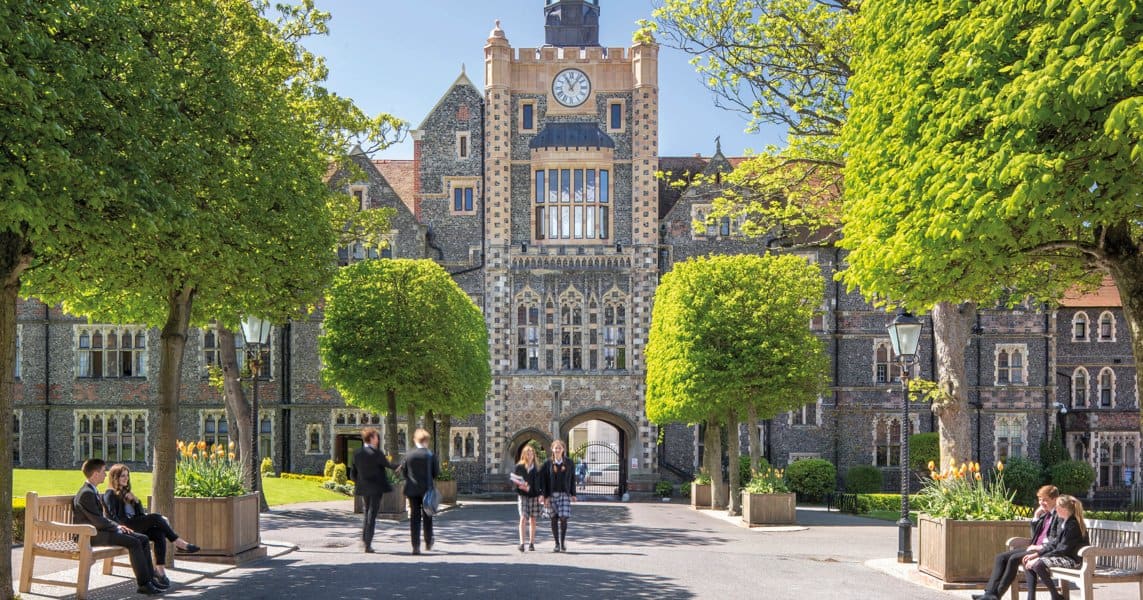
Brighton College's campus sits in central Brighton — an urban site of mostly Victorian buildings expanded with significant modern additions (the Soane Centre, the School of Science and Sport). The school is integrated with the city in a way no other top-tier UK boarding school is — Brighton itself is a creative, liberal, beach-side city of about 290,000 people, 30 minutes by foot from the Royal Pavilion, the South Downs National Park, and the sea. Pupils have natural access to galleries, theatre, beach, cafés and the South Downs from age 11. Boarding houses are integrated into the central campus rather than scattered across countryside. This shapes culture: Brighton pupils are unusually socially-fluent urban operators by Sixth Form, with the kind of city literacy that London day-schoolers develop.
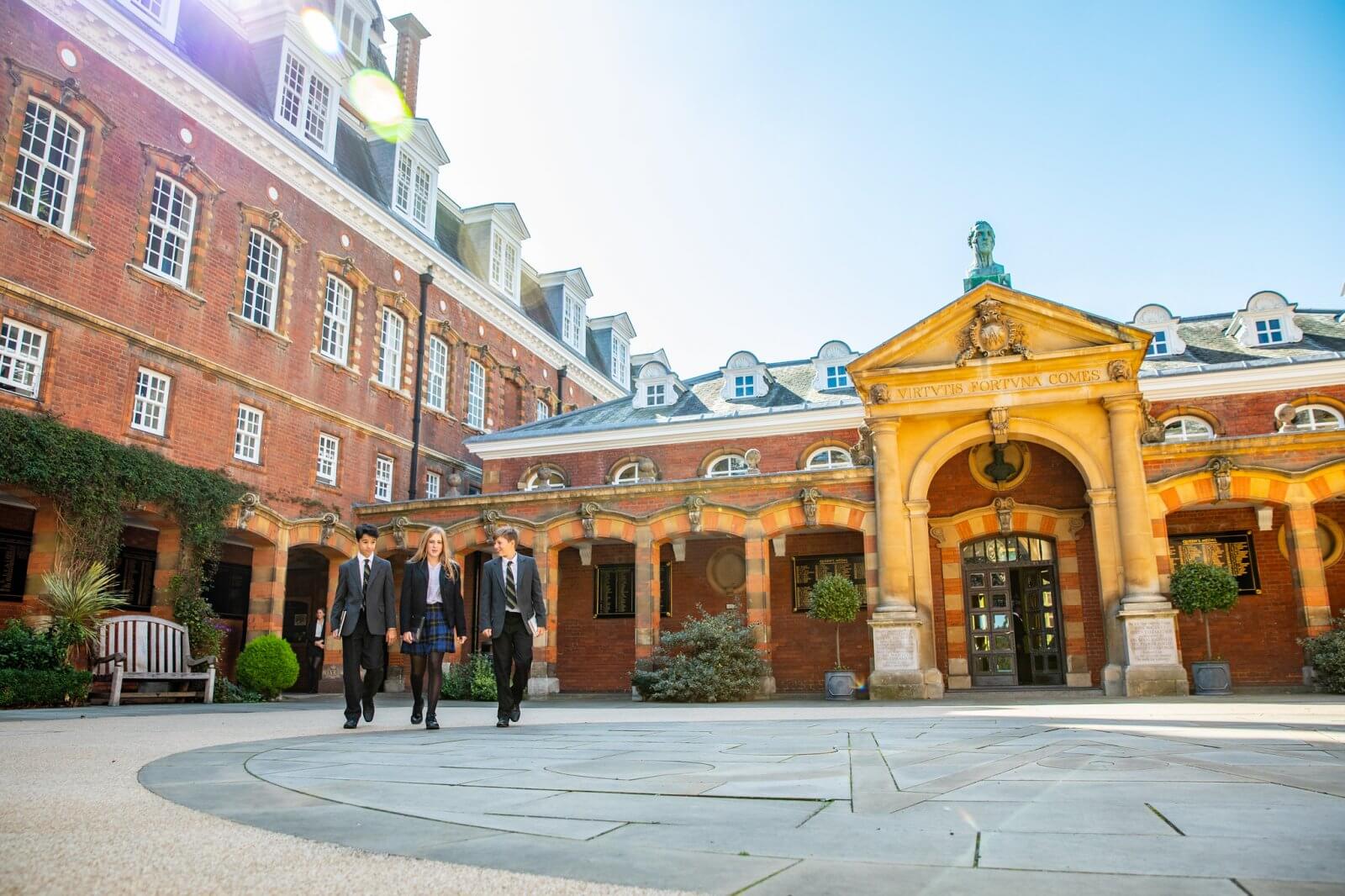
Wellington College's campus is the opposite — 400 acres of Berkshire estate, with the College built around a Grade II*-listed Victorian Italianate quadrangle commissioned by Queen Victoria herself. The estate includes the original chapel, sports pitches that host serious cricket and rugby fixtures, the Performing Arts Centre (a genuinely top-tier theatre and concert facility for a school), an extensive STEM campus, and modern boarding houses spread across the wider parkland. The atmosphere is that of a small private university — pupils live, learn and play within a contained 400-acre world. Berkshire countryside, Sandhurst proximity, and the school's military-memorial origins shape an ambient cultural identity that's both traditional and modernised.
A useful filter: Brighton operates as an urban day school with boarding option — pupils' daily experience is shaped by central Brighton's city texture, not by an estate. Wellington operates as a self-contained 400-acre country estate — pupils' daily experience is shaped by the estate, its rituals and its scale. Neither is better; they produce different kinds of adolescents.
Academics: both A-Level + IB, very different IB cohort scale
Both schools offer A-Level and IB Diploma at sixth form. Both schools' A-Level provision is strong across the full range of subjects. The meaningful difference is in IB Diploma scale and academic philosophy.
Brighton College runs A-Level as the primary track with a smaller but growing IB cohort. The school's academic identity has been built around very high A-Level outcomes — Brighton's headline 2024 result of being named Sunday Times 'School of the Decade' was driven by sustained A-Level performance. The IB cohort at Brighton is real but the experience is closer to that of an A-Level school that offers IB than to a school built around IB. For pupils targeting Oxbridge or Russell Group via A-Level, this is structurally aligned. For pupils whose strength is the IB breadth model, Brighton is workable but Wellington is more purpose-built.
Wellington College has built one of the largest IB Diploma cohorts in the UK over the last decade — by some measures the largest IB cohort of any UK independent school. The IB at Wellington is therefore fully calibrated as an academic culture rather than a parallel offering. Theory of Knowledge, Extended Essay supervision, and CAS integration are all developed at scale. The A-Level cohort remains strong but pupils targeting top US, Continental European or selective international universities particularly benefit from Wellington's IB depth. Wellington also runs the EPQ and a pre-IB Foundation Year for late entrants.
Practical filter: if your child is targeting UK universities via A-Level and you want a school with sustained top A-Level academic outcomes, Brighton's structure is aligned. If your child wants the IB Diploma as their credential — particularly if targeting US universities, European universities, or international flexibility — Wellington's IB scale gives a meaningfully richer IB experience.
Boarding mix: minority boarding vs majority boarding
Brighton College is predominantly day school. The Senior School has boarding from age 13, but day pupils outnumber boarders by a wide margin. Boarders typically come from international families, families across the UK who can't day-pupil into central Brighton, or specific year groups (e.g., Sixth Form) where boarding is a deliberate lifestyle choice. The boarding houses are integrated into the campus but the surrounding day-school culture means boarders are joining a school whose primary social rhythm is day-based.
Wellington College is predominantly boarding (~70%). The estate, the boarding houses, the weekend programming, the chapel rhythm — everything is built around a residential model. Day pupils are a meaningful minority and the school works hard to integrate them, but the cultural centre of gravity is boarding. Boarders return home for some weekends (depending on house policy) but the default expectation is on-campus weekend life through term.
Practical filter: if you want your child in a primarily day-school environment with boarding as a logistical option, Brighton's structure is the better fit. If you want the full residential boarding experience with the social rhythm and weekend culture that comes with it, Wellington's structure is purpose-built for this.
Co-educational scale and gender dynamics
Both schools have been fully co-educational for a long time — Brighton since 1990s expansion to co-ed across all years, Wellington since 2006 (fully co-ed across all years after a phased transition). The gender mix is now well-established at both schools, with balanced cohorts in current Year 9-13 groups.
Brighton's co-ed culture benefits from the urban environment — Brighton city itself is one of the more progressive UK cities, and the school's gender mix integrates without the cultural friction some traditional boarding schools have experienced. The school has invested significantly in girls' sport, female leadership programmes, and gender-balanced sixth-form academic culture.
Wellington's co-ed transition (2006 onwards) required more deliberate structural and cultural work because the school had been all-boys for 147 years prior. The school's investment in this has been visible — refurbished girls' boarding houses, female sports facilities and competitive teams, gender-balanced senior leadership and prefect structures. Current Year 9-13 cohorts are well-balanced.
Practical filter: for parents specifically looking for an environment where co-ed culture is fully integrated and the urban context reinforces gender balance, Brighton's structure is more naturally settled. For parents who want the country-estate boarding experience with the gender mix that has emerged over twenty years of deliberate work, Wellington is the choice.
Cost and financial aid
Both schools have verified published 2025-26 fees in the same overall bracket. Brighton's Year 9 termly fees are £10,470 day / £15,290 weekly boarding / £18,130 full boarding (inclusive of VAT) — annualising to roughly £31,000 day, £46,000 weekly boarding, £54,000 full boarding at Year 9. Sixth Form fees rise to around £19,000-20,000 per term for full boarding (~£57,000-60,000 per annum). Wellington's 2025-26 fees: full boarding £20,750 per term (~£62,250 per annum), day £15,250 per term (~£45,750 per annum) — both inclusive of VAT. Add roughly £4,000-7,000 annually for exam fees, books, uniforms and extras; £5,000-8,000 for travel home for international families; £3,000-5,000 for personal spending. All-in for an international family typically lands at £75,000-90,000 (USD 95,000-115,000) per year at either school.
Brighton College's financial aid includes academic and music scholarships plus need-based bursaries; awards typically cover 10-50% of fees with the option of need-based additional support. The school has invested in widening the bursary pipeline as part of its modern identity.
Wellington College's financial aid includes the Wellington Scholarships (academic, music, sport, art, all-rounder), the Wellesley Bursary (means-tested), and the Crown Bursary specifically for military families. International families are eligible for scholarships but the bursary pipeline is competitive.
Admissions: what each school weights
Both schools use the standard UK boarding admissions cycle for 13+ entry: register early (age 10-11), ISEB Common Pre-Test in Year 6, interviews in Year 7, and the school's own assessment or Common Entrance in Year 8. Sixth form 16+ entry is via separate assessment and interview in autumn of Year 11.
Brighton College is academically selective at the very top end of co-ed UK boarding — the school's Oxbridge offer rate (one of the highest in the UK independent sector) reflects a rigorous admissions filter at 13+ and 16+. Brighton looks for academically capable pupils with genuine intellectual curiosity who will benefit from the urban environment. The interview matters; the academic record matters more than at most peer schools.
Wellington College's admissions are similarly selective but with a broader weight on character, all-round development and contribution to the boarding community. The school looks for pupils who will engage fully with the estate-based residential model — interview performance reflects fit with the boarding culture as much as academic record. Wellington's IB pipeline means the school is particularly attractive to families wanting that credential, but admissions doesn't filter for IB-specific intent at 13+.
Practical timing: register at both schools by age 10-11. Sixth form 16+ entry is the second prime entry point at both, typically less competitive than 13+ for international applicants.
University placement
Headline university outcomes are very strong at both schools. Brighton College has one of the highest Oxbridge offer rates of any UK independent school, with significant flow into Imperial, LSE, UCL, Durham, Edinburgh, Bristol, St Andrews — the typical Russell Group destinations. Brighton's US Ivy + selective placement is meaningful and growing; the A-Level depth particularly supports US applications.
Wellington College places consistently to Oxford and Cambridge, with significant flow into the same Russell Group universities and notably strong US Ivy and selective placement. Wellington's IB cohort scale gives particular strength in US and European university applications — the IB Diploma is more portable than A-Level for those markets. The school has well-documented strength in Stanford, MIT, Harvard, Yale and the broader US selective university pipeline.
Both schools have excellent university counselling offices with international experience. Either school's counselling team will work effectively with a Türkiye-based family on US, UK and European applications. Wellington's IB structure gives a marginal edge for non-UK university targets; Brighton's A-Level depth gives a marginal edge for UK Russell Group + Oxbridge.
Day-to-day: Brighton city vs Berkshire estate
Brighton College's daily rhythm is shaped by the urban Brighton setting. Pupils walk to lessons through central Brighton; the lunch experience, weekend programming, and after-school options all benefit from the city around the school. Beach access is 15-20 minutes' walk away; the South Downs are 25 minutes; London is 90 minutes by direct train. This shapes graduates: Brighton pupils typically develop the kind of urban cultural fluency that London independent-day-school pupils develop, plus the coastal city's specific liberal-creative culture.
Wellington College's daily rhythm is shaped by the 400-acre estate. Mornings start with chapel, classes run through the day in academic buildings on the estate, afternoon sport happens on the school's own pitches (Wellington has a genuinely top-tier sports programme — rugby, cricket, hockey, athletics all serious). Weekends include the school's Friday-night and Saturday-evening cultural programming, Sunday chapel and walks across the estate, and structured trips into Reading, Windsor or Oxford as appropriate. The estate is the world; pupils develop deep familiarity with the place.
Practical filter: Brighton shapes adolescents with strong urban cultural literacy and natural city-social fluency. Wellington shapes adolescents with strong community bonds, sport and music habits, and an extended residential community identity.
Who Brighton College is the right call for
We typically recommend Brighton College when the family values exceptional A-Level academic outcomes combined with an urban-coastal lifestyle, when the child would thrive in the cultural and social texture of central Brighton, and when the family wants a primarily day-school structure with optional boarding. Strong fit for academically driven pupils targeting Oxbridge and top Russell Group via A-Level, for families whose child would benefit from urban cultural fluency, and for international families wanting their child to develop strong English social skills in a progressive, creative city environment.
Less of a fit for children who specifically want the country-estate boarding experience, who need a primarily IB Diploma environment, or who would feel overwhelmed by central-city urban texture. Brighton's structure works best for pupils who can thrive in a city-integrated school; pupils who would benefit from more contained countryside isolation tend to do better at Wellington.
Who Wellington College is the right call for
We recommend Wellington College when the family wants the full country-estate boarding experience at scale, when the child is IB-pathway oriented (or wants the credential optionality of IB alongside A-Level), and when the family values the residential community model with strong sport, music and pastoral structures. Strong fit for international families wanting their child to fully immerse in UK boarding culture, for IB-targeting pupils particularly aiming at US, European or international universities, for families valuing the Round Square global network and Wellington International sister schools (China/Thailand/India), and for adolescents who would thrive in the rhythms of a 400-acre contained world.
Less of a fit for children who specifically want urban cultural access throughout school, who are A-Level pure-track focused with no IB interest, or for families wanting a primarily day-school structure. Wellington's strength is in residential boarding; pupils who can't fully commit to the boarding model will under-experience the school.
The advisor's take
Both schools are exceptional UK co-ed boarding options at a similar fee point. The mistake families make is treating them as interchangeable — they aren't. If we had to compress our advice into one sentence: choose Brighton College if you want your child in a primarily day-school structure with exceptional A-Level outcomes and central Brighton's urban-coastal culture; choose Wellington College if you want the full country-estate boarding experience with the largest IB Diploma cohort in UK independent education and a residential community model.
If neither captures it, the next layer of UK co-ed boarding — Marlborough (Wiltshire, A-Level + Pre-U, integrated with working English town), Stowe (Buckinghamshire, A-Level + Pre-U, Vanbrugh country house estate), Charterhouse (Surrey, A-Level + IB, contained estate), Oundle (Northamptonshire, A-Level + EPQ, engineering-strong) — solves different problems. We are happy to talk through that. Our advisor Kevin from London handles UK boarding placements and has deep current intel on Year 9 and 16+ availability at all of these schools for September 2026 and 2027 entry.
Frequently asked questions
- Brighton College or Wellington — which is more academic?
- Both are academically strong at the top end of UK independent boarding. Brighton was named The Sunday Times 'School of the Decade' for academic results in 2024 — the school has one of the highest Oxbridge offer rates of any UK independent school via its A-Level pipeline. Wellington's academic identity is built more around the IB Diploma at scale plus strong A-Level provision. If your child is A-Level focused and targeting Oxbridge / Russell Group, Brighton edges marginally. If targeting IB Diploma for US or European universities, Wellington's IB scale gives the edge.
- Does Wellington really have the largest IB Diploma cohort in the UK?
- Wellington College has built one of the largest IB Diploma cohorts in UK independent education over the last fifteen years — by some published measures the largest. The school made this a deliberate strategic choice. The result is that IB at Wellington is fully calibrated as an academic culture (Theory of Knowledge, Extended Essay supervision, CAS integration all developed at scale), rather than a smaller parallel offering. For families specifically choosing for IB, this scale matters.
- How do the fees compare?
- Both schools' verified 2025-26 fees are in similar ranges (inclusive of VAT). Wellington full boarding £20,750/term (~£62,250 per annum), day £15,250/term (~£45,750/year). Brighton Year 9 full boarding £18,130/term (~£54k/year), rising to ~£19-20k/term at Sixth Form (~£57-60k/year); day £10,470/term (~£31k/year). All-in for international families (with travel, extras) typically £75,000-90,000 GBP (USD 95,000-115,000) per year at either school.
- Is Brighton really Sunday Times 'School of the Decade'?
- Yes — Brighton College was named The Sunday Times 'School of the Decade' for academic results in 2024, recognising sustained A-Level performance over the ten preceding years. This was a meaningful UK independent-sector recognition based on a quantitative academic-outcomes methodology.
- What's the boarding mix at each school?
- Brighton College is predominantly a day school with boarding option — day pupils outnumber boarders significantly. Wellington College is predominantly boarding (~70% of senior school pupils). If you want the full residential boarding experience as the school's central social rhythm, Wellington's structure is the right fit; if you want a day school with boarding as a logistical option, Brighton's structure is the right fit.
- Which school is better for international families specifically?
- Both schools have well-established international family programmes and strong visa support. Wellington's residential model and Round Square / Wellington International network (with sister schools in China, Thailand and India) creates a deeper international community. Brighton's urban environment in central Brighton city gives international pupils strong English social integration. The choice depends on whether the country-estate residential model or the urban day-school model fits your child better.
- How accessible are the schools from London?
- Brighton is 90 minutes by direct train from London Victoria to Brighton, then 15 minutes by taxi or 25 minutes by foot. Wellington is 70 minutes by train from London Waterloo to Crowthorne, then 15 minutes by taxi. Both are accessible for parent visits, term-end pickups and weekend exeats.
- When did each school become fully co-educational?
- Brighton College has been fully co-educational across all year groups since the 1990s. Wellington College went fully co-educational across all years in 2006 (after a phased transition; earlier co-ed from sixth form). Both schools' current Year 9-13 cohorts are well-balanced by gender, with mature co-ed cultures.
See how this article maps to your child's profile.
Run our 5-step AI Match — we'll factor in the trade-offs covered above.
Start AI MatchTalk to a senior education advisor.
AI helps you shortlist. Our advisors help your family decide — with a decade of admissions experience across UK, Switzerland, North America and Asia.