Best international schools in the Netherlands 2026: a complete guide for relocating families
The Netherlands quietly hosts one of Europe's most cost-effective international school markets — thanks to a Dutch government subsidy that keeps fees a fraction of London or Geneva. Here's the operational guide for 2026, school-by-school.
When Turkish families think about international school options in Europe, they usually start with the UK and Switzerland. The Netherlands is rarely the first market that comes up — and that's a mistake. The Dutch international school sector is one of the largest, oldest, and most cost-effective in Europe. It runs on a quietly remarkable model: the Dutch government subsidises a network of accredited international schools (the 'Dutch International Education' programme, or DAIS), which keeps fees at a fraction of what families pay in London, Geneva, or Munich for academically equivalent IB outcomes.
This guide walks through the Dutch international school market as it exists in 2026 — geographically, financially, and operationally. We cover the four main international school hubs (Amsterdam, The Hague, Eindhoven, Rotterdam), the cost reality (yes, EUR 6,000-12,000 per year for a full IB programme is real if your child qualifies), the curriculum split (IB Continuum dominates), and the four family scenarios that map to the four major schools. If you're considering the Netherlands for your child's secondary education — or relocating with an employer — this guide is for you.
**Why the Netherlands works for international families.**
Three structural factors make the Dutch market unusually attractive in 2026. First, English fluency is near-universal: the Netherlands ranks #1 globally in the EF English Proficiency Index, so your child can navigate daily life, social settings, and university applications in English from day one. Second, the Dutch international school infrastructure is built around expatriate corporate families — ASML in Eindhoven, Shell and the international institutions in The Hague, Erasmus University and the port in Rotterdam, finance and creative industries in Amsterdam — so the schools have decades of experience with mobile families and rolling admissions. Third, the partial government subsidy through the DAIS programme means a full IB Continuum at a recognised international school can cost EUR 6,000-12,000 per year per child, depending on residency and registration status. That's a fraction of comparable schools in London (£25-45k/yr) or Geneva (CHF 28-40k/yr).
There's a caveat worth stating upfront: the DAIS-subsidised pricing applies primarily to children of expatriate parents (defined as families whose primary purpose for being in the Netherlands is non-permanent, typically employment-driven). Children of Dutch citizens or long-term permanent residents pay higher rates at the same schools. We walk through the eligibility rules below.
**The four Dutch international school hubs.**
Dutch international schools cluster around four cities, each with its own economic identity and family profile. Understanding which hub fits your relocation context is the highest-leverage decision before school selection.
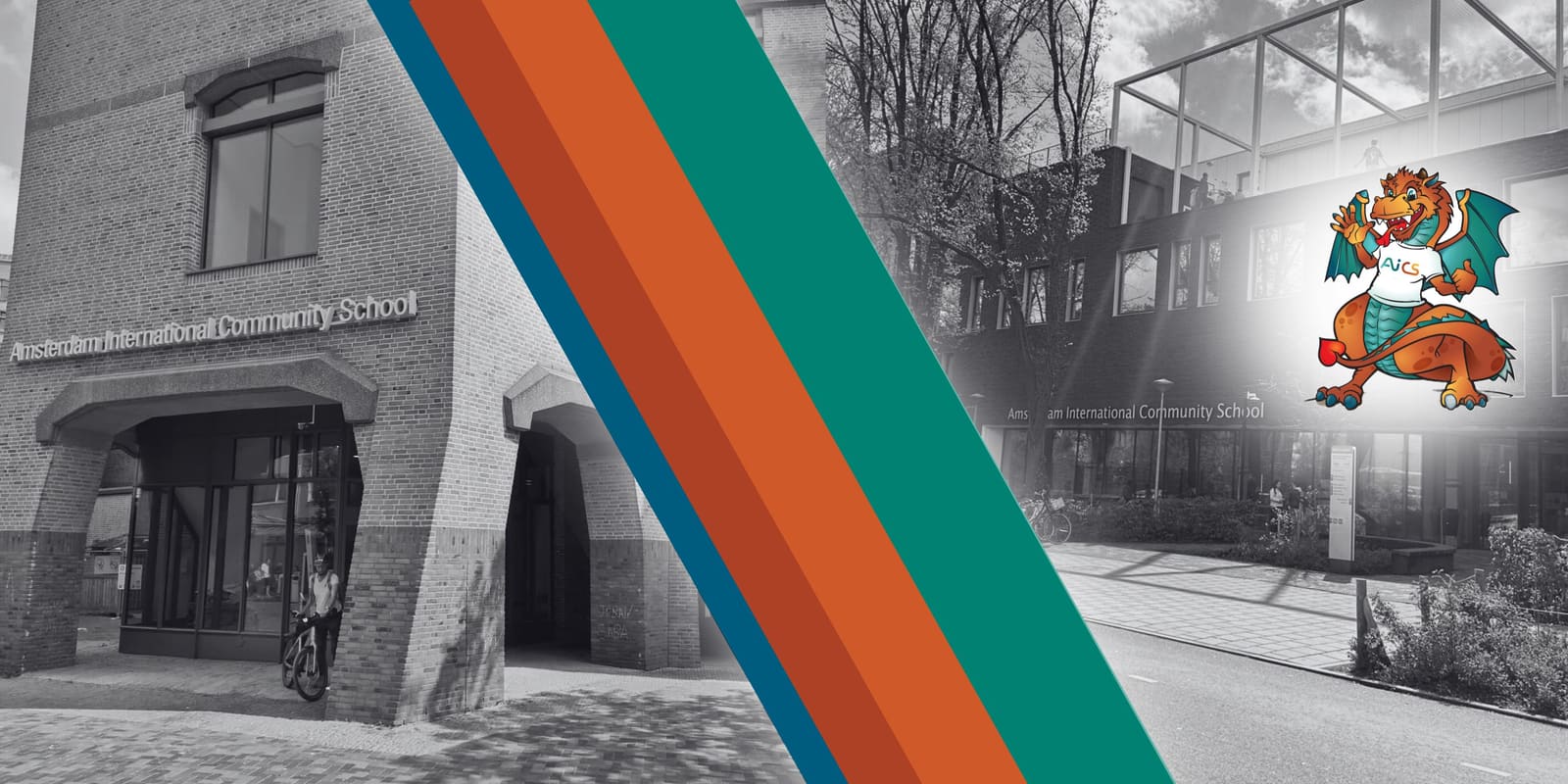
**Amsterdam — finance, tech, creative industries.** Amsterdam has become Europe's quiet tech and finance challenger to London since Brexit — many UK-headquartered banks, asset managers and tech firms now operate significant Amsterdam offices. The international family profile here skews younger (parents in their 30s-40s in mid-senior corporate or founder roles), more dual-career, more start-up-adjacent. The flagship international school is Amsterdam International Community School (AICS), part of the Esprit Scholen foundation and a DAIS-subsidised IB World School. AICS runs the full IB Continuum across multiple Amsterdam locations (primary in Amstelveen and South Amsterdam, secondary in Amsterdam Zuidoost) with ~1,400 students. Waiting lists are common because the supply hasn't kept pace with the post-Brexit family relocation wave.
**The Hague — diplomatic, legal, energy.** The Hague is the seat of the Dutch government, the International Court of Justice, the OPCW (Organisation for the Prohibition of Chemical Weapons), the International Criminal Court, and Royal Dutch Shell's headquarters. The international family profile here is the most diplomatic and corporate-senior of the four hubs. The flagship school is American School of The Hague (ASH) in Wassenaar — founded 1953, making it the longest-running American international school in the Netherlands, with ~1,200 students across grades PK-12 and a curriculum that runs the American high school diploma with AP courses alongside the IB Diploma at the Upper School. ASH is fully private (not DAIS-subsidised), so its fees are higher — EUR 20,325 for Pre-Kindergarten rising to EUR 29,000 for Grades 9-12 in 2026-27 — but that's still 30-40% below comparable American international schools in London or Frankfurt.
**Eindhoven — the Brainport tech ecosystem.** Eindhoven is the home of Philips, ASML (the company that makes the lithography machines that make every advanced semiconductor), NXP, and the wider 'Brainport' high-tech manufacturing cluster. The international family profile here is the most engineering and STEM-heavy of the four hubs — many German, Korean, Chinese, Indian, and American semiconductor and electronics families. The flagship is International School Eindhoven (ISE), founded 1981, ~1,400 students aged 4-19 across a primary and secondary campus. ISE is DAIS-subsidised — published 2025-26 fees are remarkable: EUR 6,394 per child for primary, EUR 8,192-9,050 per child for secondary IB MYP through DP. Full IB Continuum (PYP, MYP, DP) and CIS-accredited.
**Rotterdam — port, logistics, applied sciences.** Rotterdam is Europe's largest port and home to Erasmus University Rotterdam (a top-50 European research university). The international family profile here mixes shipping/logistics multinational seniors with Erasmus academic and medical faculty. The flagship private international school is Nord Anglia International School Rotterdam (NAISR), founded 2002, ~700 students aged 3-18. NAISR runs the full IB Continuum and is part of the global Nord Anglia network of 90+ international schools, with the network's STEAM partnership with MIT and performing arts partnership with the Juilliard School. NAISR is fully private (not DAIS-subsidised), with fees that approximate the lower end of typical fully-private European international schools.
**Dutch International Schools (DAIS) vs fully private: the cost split that defines the market.**
The single most important concept to understand about the Dutch market is the DAIS framework. The Dutch Ministry of Education recognises a network of approximately 25 international schools (primary and secondary) as 'Dutch International Education' providers. These schools receive partial government subsidies in exchange for educating children of internationally mobile families to internationally recognised curricula (typically IB). The subsidy makes published fees substantially lower than what the same school would cost without it.
DAIS eligibility (oversimplified): the family is in the Netherlands for time-limited reasons (typically work assignment, posting, or contract), the child needs an internationally portable curriculum (IB Diploma is the standard portable credential), and the family is not a permanent Dutch resident. Children of Dutch nationals are generally not DAIS-eligible at the same school and pay higher fees (often 2-3× the DAIS rate). For most internationally relocating families from Türkiye, Saudi Arabia, the Gulf, India, China, the UK, or the US — DAIS eligibility is straightforward.
The schools that operate in the DAIS framework (in our catalogue) include AICS Amsterdam and ISE Eindhoven. Schools that operate fully private include ASH The Hague and NAISR Rotterdam. The cost gap is roughly 3-5×: DAIS schools cost EUR 6,000-12,000 per year, fully private cost EUR 20,000-30,000 per year. The academic quality differential is much smaller than the cost differential suggests — DAIS schools include some of the most academically respected IB programmes in the Netherlands.
**Curriculum reality: IB Continuum is the standard, with American as the second option.**
Three of the four schools we've added (AICS Amsterdam, ISE Eindhoven, NAISR Rotterdam) run the full IB Continuum — PYP at primary, MYP at middle school, DP at sixth form. This is the dominant pattern across the Dutch international sector. American School of The Hague is the exception: it offers the American high school diploma with AP courses alongside the IB Diploma at the Upper School, letting families pick US-pathway or international-pathway depending on target universities.
If your child is in or approaching the IB age range (Grade 6 / age 11 entering MYP, or Grade 11 / age 16 entering DP), the Dutch IB schools are particularly well-aligned. The IB Diploma is the dominant credential into Dutch universities, the rest of European Union, and the UK / US / Canada — so the IB choice is portable wherever your family ends up next. If your child is American-pathway oriented (targeting US universities specifically), ASH's American Diploma with AP is the strongest local fit; many ASH graduates matriculate to top US universities.
**Admissions reality: rolling but with waiting lists.**
Dutch international schools generally accept rolling admissions throughout the academic year — there's no single annual deadline like the UK 13+ or US October application. In practice, however, the schools have capacity caps and many operate active waiting lists. AICS Amsterdam in particular has a multi-year waiting list at primary entry points because Amsterdam family relocations have outpaced supply. ISE Eindhoven has tighter capacity than waiting-list visibility suggests — ASML's continued global expansion has driven Brainport family inflow.
Practical guidance: if you're relocating to the Netherlands and the school you want has a waiting list, call admissions directly and explain your timeline. Schools generally prioritise time-sensitive corporate relocations and can sometimes find spaces by re-balancing the cohort across age groups. Schools that say 'apply 12-18 months ahead' usually mean it — but the same schools have August-September openings every year when last-minute relocations come through.
**Visa and travel realities for Türkiye-based families.**
Dutch student and family visa processing is among Europe's most efficient. For relocating families, the typical pattern is: the employer arranges a Highly Skilled Migrant (Kennismigrant) work visa for the working parent, which automatically extends to family members. The Highly Skilled Migrant visa is fast (typically 2-4 weeks processing) and renewable. For families relocating without employer sponsorship, the route is more complex and usually requires a separate self-sponsored work or study visa.
Direct flights between Istanbul and Amsterdam are operated daily by Turkish Airlines and KLM (3.5-4 hours). For families based in Türkiye, Amsterdam is the most accessible Dutch hub by direct flight; The Hague is 50 minutes by train from Amsterdam Schiphol airport; Eindhoven and Rotterdam are 1-1.5 hours by train. For families based in Ankara, Izmir, or other Turkish cities, the most common transit pattern is via Istanbul on Turkish Airlines.
School breaks in the Netherlands follow the national calendar: 1-week autumn break (October), 2-week Christmas break, 1-week spring break (February), 2-week May break, 6-week summer break. Dutch schools generally do not operate boarding houses (the Netherlands is not a boarding-school market — all four of our covered schools are day schools), so all families need accommodation arrangements for the school year.
**Who fits which Dutch school: four family scenarios.**
**Scenario 1 — Turkish corporate family relocating to Amsterdam for finance / tech work, child age 8.** Best fit: AICS Amsterdam. Reasoning: AICS is DAIS-subsidised so the cost is manageable (~EUR 8-10k/year), the IB Continuum starts at primary level so the child gets the full PYP-MYP-DP pathway, the school has the longest experience with corporate-mobile families in Amsterdam. Action: apply early (waiting lists are real) and have the employer's relocation team flag school placement as a priority.
**Scenario 2 — Diplomatic/UN family in The Hague, child age 14.** Best fit: American School of The Hague (ASH). Reasoning: ASH is the longest-running international school in the Netherlands, the AP + IB dual track gives flexibility for US universities or European pathways, the Wassenaar campus is in the same neighbourhood as most diplomatic housing. ASH is more expensive than the DAIS schools (~EUR 27-29k/year for upper grades) but the diplomatic compensation packages typically cover school fees. Action: ASH admissions is well-tuned to diplomatic timing — apply on the standard cycle and don't oversweat the timing.
**Scenario 3 — Engineering family relocating to Eindhoven for ASML / NXP, child age 12.** Best fit: International School Eindhoven (ISE). Reasoning: ISE is DAIS-subsidised (~EUR 8k/year for MYP), the IB Continuum is well-established, the cohort skews heavily engineering / STEM family which means the child finds peers from similar backgrounds. The Brainport region has the highest international engineering family density in the Netherlands. Action: apply through the standard ISE process; ASML's relocation services often have established channels with the school.
**Scenario 4 — Multinational family relocating to Rotterdam for shipping / port / Erasmus University faculty, child age 10.** Best fit: Nord Anglia International School Rotterdam (NAISR). Reasoning: NAISR is fully private (so the cost is higher, ~EUR 22-28k/year) but the school is part of the global Nord Anglia network which means continuity if the family relocates to another Nord Anglia city later (Hong Kong, Dubai, Madrid, etc.). The Juilliard and MIT partnerships are real and accessible to NAISR students. Action: apply early; NAISR has smaller capacity (~700 students total) than the DAIS schools.
**The Dutch cost advantage.**
Here's the comparative math that makes the Netherlands attractive for families who haven't considered it. A family with one child in Grades 9-12 at AICS Amsterdam (DAIS, IB Diploma): roughly EUR 36,000 across four years of upper-school fees. The same child at a comparable IB school in London: roughly £140,000 (~EUR 165,000). In Geneva: roughly CHF 145,000 (~EUR 155,000). In Zurich: roughly CHF 160,000 (~EUR 170,000). The Dutch DAIS option is 75-78% cheaper than the alternatives, for an academically equivalent IB Diploma cohort.
Even at the fully private end (ASH or NAISR), Dutch schools run 30-45% below London or Swiss equivalents for the same curriculum. For families who are mobile and can choose where to base in Europe, the Netherlands offers the strongest cost-quality ratio of the four major Western European markets.
**The mistakes families make.**
First: assuming all 'international schools' in the Netherlands are equivalent. The DAIS schools and the fully private schools run different cost models, different admissions tempos, and slightly different academic cultures. Filter your shortlist by which framework you qualify for first, then by city.
Second: under-budgeting for the relocation. Dutch international schools are cheaper than London or Geneva equivalents, but Dutch housing in Amsterdam-South or Wassenaar is not cheap — and the housing decision is often more financially significant than the school decision for relocating families.
Third: applying to one school and waiting. If your child has a hard September entry date, apply to two or three schools in your target city. The Dutch market is well-supplied but specific year-group capacity is tight; having a backup avoids painful September scrambles.
Fourth: skipping the curriculum continuity question. If your child has just finished American 8th grade and is moving to Dutch international Grade 9, the IB MYP-to-DP transition is smoother than American-to-IB at age 14. Talk to the admissions office about your child's specific transcript and they'll be candid about which programme fits.
**Where to start.**
If you're at the beginning of your Dutch international school research: run our AI Match (3 minutes) with 'Netherlands' as the target country — we'll surface the schools that fit your child's age, curriculum preference, and budget. If you're already shortlisting and want an honest second opinion on AICS vs ASH vs ISE vs NAISR: book the advisor call. Dilek (our co-founder, based between London and Istanbul) has placed families across all four hubs and can talk through the relocation-versus-stay-in-Türkiye trade-off honestly.
If you'd like to read more before deciding: our IB Diploma complete guide walks through what IB asks of a 16-year-old, our International school cost comparison piece covers the all-in numbers across UK, Switzerland, USA, Canada and Singapore (the Netherlands is a meaningful add-on to those calculations), and our 12-month school search timeline lays out what to do month-by-month for a September entry.
See how this article maps to your child's profile.
Run our 5-step AI Match — we'll factor in the trade-offs covered above.
Start AI MatchTalk to a senior education advisor.
AI helps you shortlist. Our advisors help your family decide — with a decade of admissions experience across UK, Switzerland, North America and Asia.