Amsterdam International Community School (AICS) 2026: a complete advisor guide to Amsterdam's flagship DAIS-subsidised IB school
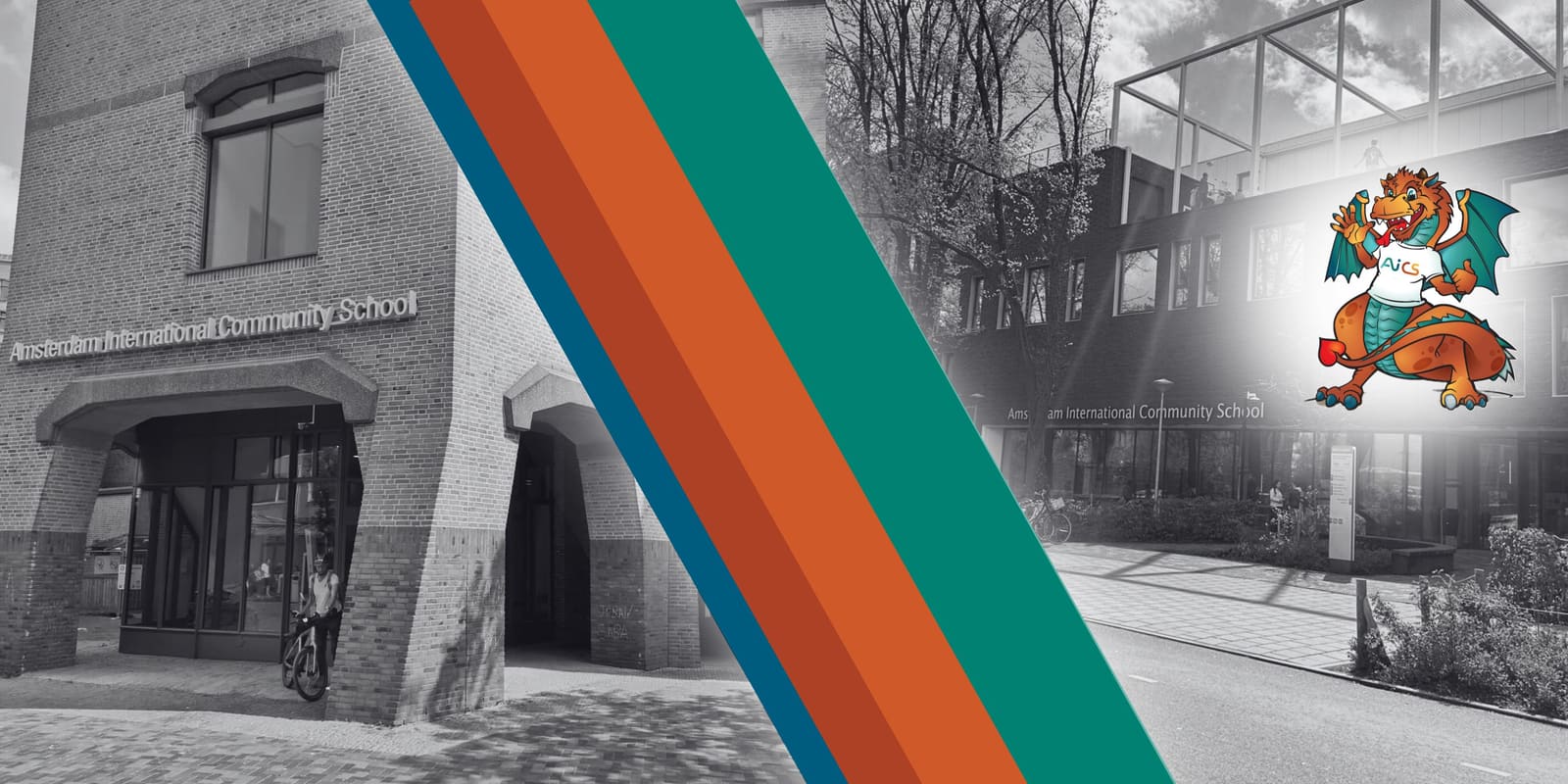
AICS is Amsterdam's flagship international school — a DAIS-subsidised IB World School where families pay a fraction of comparable London or Geneva fees for the same IB Continuum. Here's the operational 2026 guide.
Amsterdam International Community School (AICS) is the Amsterdam international school we recommend most often to Turkish families relocating to the Netherlands for finance, tech, or creative-industry work. Founded in 2003 as part of the Esprit Scholen foundation, AICS sits in a distinctive structural category: a Dutch International School (DAIS) operating with partial Dutch government subsidy in exchange for serving internationally-mobile families to internationally recognised IB curriculum standards. The result is a full IB Continuum school — PYP, MYP, Diploma Programme — at approximately one-third the published fee of comparable London IB schools and one-quarter the fee of comparable Swiss day schools.
We advise Turkish families considering AICS every admissions cycle, particularly families relocating to Amsterdam for corporate or tech work who qualify for DAIS pricing. The school's combination of full IB Continuum, large cohort (~1,400 students), three city locations, and the dramatic DAIS cost advantage makes it structurally one of the strongest cost-quality propositions in European international schooling — but with the meaningful caveat that DAIS eligibility constraints apply, waiting lists are real, and the school is not the right fit for every family.
This guide walks through AICS's distinctive structure, the DAIS subsidy framework, the three Amsterdam locations, the admissions reality (including waiting lists), and who specifically fits the cohort. Read top to bottom if you're early in the process. Skip to specific sections if you're already engaging with admissions.
The 60-second profile
AICS was founded in 2003 in Amsterdam as part of the Esprit Scholen foundation — a Dutch educational organisation operating multiple Amsterdam schools across primary, secondary and international tracks. About 1,400 students aged 4-18 from 60+ nationalities, day only (no boarding), across three Amsterdam locations: Amstelveen (primary), South Amsterdam (primary), and Amsterdam Zuidoost (secondary). The full IB Continuum runs across all years — PYP at primary, MYP at middle school, Diploma Programme at sixth form.
DAIS status (Dutch International School): AICS is recognised by the Dutch Ministry of Education as a Dutch International School, receiving partial government subsidy to serve internationally-mobile families with internationally recognised curriculum. This subsidy dramatically lowers fees for families who meet the DAIS eligibility criteria (essentially, families whose primary purpose in the Netherlands is time-limited work or assignment, not permanent residency).
Fees for DAIS-eligible families: typically EUR 6,000-12,000 per year per child depending on age group. For Dutch citizens or long-term Dutch residents not qualifying for DAIS: fees are 2-3x higher (closer to typical Dutch private international school rates). The fee differential between DAIS and non-DAIS at AICS is genuine — families should verify their DAIS eligibility early in the admissions process rather than assuming the published DAIS rate will apply.
All-in for a Turkish DAIS-eligible family at AICS typically lands at EUR 10,000-16,000 (USD 11,000-17,000) per year per child including all charges — making AICS approximately one-fifth the cost of comparable Swiss day IB schools and one-third the cost of London IB schools for equivalent curriculum.
The DAIS subsidy framework explained
The single most important concept to understand about AICS — and the reason it warrants its own focused deep-dive — is the DAIS framework. The Dutch government, through the Dutch Ministry of Education, recognises a network of approximately 25 international schools across the Netherlands as 'Dutch International Education' (DAIS) providers. These schools receive partial state subsidies to serve children of internationally-mobile families, with the stated goal of supporting the Netherlands' positioning as a destination for international corporate, diplomatic and scientific relocations.
**DAIS eligibility (simplified):** the family is in the Netherlands for time-limited reasons (typically employment-driven, with a defined assignment period rather than permanent residency), the child requires an internationally portable curriculum (IB Diploma is the standard portable credential, alongside other international qualifications), and the family is not a permanent Dutch resident. For most internationally-relocating Turkish families on corporate assignment, DAIS eligibility is straightforward and the corporate HR / relocation team will typically navigate the documentation.
**Children of Dutch nationals and long-term residents** are generally not DAIS-eligible at the same schools and pay higher fees (typically 2-3x the DAIS rate). This is a deliberate policy choice — DAIS subsidies are intended for internationally-mobile families, not for Dutch families seeking lower-cost private international schooling.
**Practical implication for fees:** AICS publishes two fee schedules — the DAIS-subsidised rate and the non-DAIS rate. The DAIS-subsidised rate is what makes AICS one of Europe's most cost-effective IB schools (typically EUR 6,000-12,000 per year per child). The non-DAIS rate (typically EUR 20,000-30,000+ per year) is closer to typical fully-private Dutch international school pricing and substantially less competitive versus alternatives.
**For Turkish families:** confirm DAIS eligibility with AICS admissions early. The school is structured around the DAIS framework — non-DAIS families can attend but the value proposition shifts. If you're permanently relocating to the Netherlands as Dutch residents rather than on time-limited assignment, the financial case for AICS is meaningfully weaker.
Three Amsterdam locations: structural geography
AICS operates across three distinct Amsterdam locations, with primary and secondary years split geographically:
**AICS Amstelveen (Primary).** Located in Amstelveen, a residential municipality immediately south of Amsterdam with a long-established expatriate community (close to Schiphol airport and many international corporate offices). Serves PYP-age students (typically ages 4-11). Family profile skews corporate-expatriate.
**AICS South Amsterdam (Primary).** Located in the southern districts of Amsterdam proper, closer to the Zuidas business district (Amsterdam's main financial centre, home to many international banks and tech firms). Serves PYP-age students with similar curriculum to Amstelveen. Family profile slightly more central-Amsterdam corporate and creative.
**AICS Amsterdam Zuidoost (Secondary).** Located in Amsterdam Zuidoost (Amsterdam-southeast), serving MYP and DP students (typically ages 11-18). The secondary cohort consolidates students from both primary locations plus new mid-school and sixth-form entrants. Family profile expands further to include international families from across the broader Amsterdam region.
**Practical implication:** when applying to AICS, your child's age determines which location they'll attend. Families with multiple children spanning primary and secondary ages will have children at different campuses. Geographic logistics matter — daily commute from a single family residence to two AICS locations needs planning. Most families choose their Amsterdam residential location partly based on AICS proximity (the southern and southeast districts are typical for AICS families).
The single-foundation, three-location structure means the school's pedagogy, curriculum, and quality standards are consistent across locations — AICS Amstelveen and AICS South operate the same IB PYP framework with the same Esprit Scholen oversight.
IB Continuum: PYP, MYP, Diploma Programme
AICS runs the full IB Continuum across all three programmes:
**Primary Years Programme (PYP, ages 4-11).** Inquiry-led primary curriculum across six transdisciplinary themes. Taught in English with embedded Dutch language exposure (the school's location in the Netherlands makes Dutch a natural second language for international students who may stay long-term). PYP at AICS is one of the most-established PYP cohorts in Northern Europe given the school's 2003 founding and Esprit Scholen institutional support.
**Middle Years Programme (MYP, ages 11-16).** Eight subject groups with project-based learning and the MYP Personal Project (independent research) in the final year. Strong academic preparation for IB Diploma. Located at the AICS Amsterdam Zuidoost campus alongside the Diploma Programme.
**IB Diploma Programme (DP, ages 16-18).** Standard IB Diploma — six subjects (three Higher Level, three Standard Level), plus Theory of Knowledge, Extended Essay, and CAS. AICS Diploma cohort is well-established with strong published outcomes and university placement.
**Practical filter:** AICS is purely IB Continuum. If you specifically want the American high school diploma + AP option, AICS is not the structural fit — the American School of The Hague (ASH) or specific other Dutch international schools serve that market. If you want IGCSE + A-Level (British curriculum), the British School in the Netherlands or specific British international schools in the Netherlands serve that market. AICS's value proposition is IB Continuum + DAIS subsidy.
Cohort culture
AICS's cohort is genuinely international — 60+ nationalities across the three locations with strong representation from corporate-expat families (finance, tech, professional services, creative industries), diplomatic families (Amsterdam has a smaller diplomatic community than The Hague but still meaningful), and academic families (the University of Amsterdam and Vrije Universiteit attract international faculty). Turkish-international families have a meaningful AICS presence, particularly families relocating for finance or tech work.
The Esprit Scholen foundation context matters for cohort culture. AICS operates alongside other Esprit Scholen schools serving Dutch and international populations — this creates an institutional environment that's distinctly Dutch-international rather than purely expatriate-bubble. Students engage with Dutch culture, language, and social norms more naturally than at some hermetically-sealed international schools elsewhere in Europe. For Turkish families who plan to stay in the Netherlands long-term or who want their child to develop Dutch cultural fluency alongside English, this is a structural advantage.
**Pace and academic register:** AICS's IB Diploma cohort produces strong but not exceptionally high published average scores. The school operates as a solid IB World School in the mid-30s to high-30s average range (out of 45) — comparable to other major DAIS IB schools, slightly below the very top Swiss alpine schools or London IB-heavy schools that operate above 40. For most families this distinction matters less than the cost-quality ratio: AICS delivers a strong IB Diploma at a fraction of the cost of higher-fee peers.
**For Turkish families specifically:** AICS has a meaningful Turkish presence in the cohort. Your child will integrate naturally if they're comfortable in a Northern European urban Dutch context. The cohort is less Anglosphere-dominant than London internationals — Dutch, German, Continental European, Asian and Middle Eastern student profiles are more prominent.
Cost reality: detailed DAIS economics
AICS's fee structure is the most distinctive economic feature of any IB school we cover. Here's the detailed picture:
**DAIS-subsidised rates (for qualifying internationally-mobile families):** typically EUR 6,000-8,000 per child per year for PYP (primary); EUR 8,000-10,000 for MYP (middle school); EUR 10,000-12,000 for Diploma Programme (sixth form). Fees scale with year group reflecting the increased operating cost of senior school provision (smaller classes, IB exam fees, more specialised teaching).
**Non-DAIS rates (for Dutch citizens, long-term residents, or families who don't qualify for DAIS):** typically EUR 18,000-30,000+ per child per year. These rates are closer to fully-private Dutch international school market pricing.
**All-in for a Turkish DAIS-eligible family** at AICS typically lands at EUR 10,000-16,000 (USD 11,000-17,000) per child per year including registration fees, books, lunches, school trips, and incidentals. For comparison: a Turkish family at a London IB school typically pays GBP 30,000-45,000 (USD 38,000-57,000) per year per child for equivalent IB Continuum education; at a Swiss day IB school like Ecolint Geneva, CHF 35,000-40,000 (USD 38,000-44,000) per child per year at senior school.
**Comparative annual savings for a Turkish family:** at AICS DAIS rates, savings of EUR 18,000-30,000 per child per year vs comparable London or Swiss day schools. Across a five-year IB run (Grade 8-12), that's EUR 90,000-150,000 in fees alone — substantially below the cost of relocating to London or Geneva for international IB education. For families with multiple children, the savings multiply.
**The caveats:** DAIS eligibility is real and depends on your family's residency situation. The Netherlands as a country has higher cost of living for housing (particularly in Amsterdam) than the published fee differentials suggest — Amsterdam housing costs partially offset the school-fee advantage. And DAIS subsidies are subject to Dutch government policy decisions; the current framework has been stable but is not constitutionally guaranteed.
Admissions reality: waiting lists
AICS has maintained active waiting lists at primary entry points for many years. The Amsterdam international family market has grown faster than school capacity (particularly post-Brexit Amsterdam family relocations), and AICS — as the dominant DAIS-subsidised IB Continuum school — has been at the leading edge of capacity tightness.
**Practical waiting-list reality:** PYP (primary) entry at AICS Amstelveen and AICS South Amsterdam typically has 6-18 month waiting lists at popular age points. MYP middle-school entry is somewhat more flexible. Diploma Programme entry (Grade 11 / DP1) has been more accommodating recently as the school has expanded sixth-form capacity.
**Practical guidance for time-sensitive Turkish family relocations:** if you've accepted a corporate role in Amsterdam and need a September 2026 AICS placement, apply immediately and have your employer's relocation team escalate the application through their established AICS channel. AICS prioritises time-sensitive corporate relocations to the extent possible, but waiting-list realities mean placement is not guaranteed for late applications.
**Backup planning:** apply to 2-3 schools simultaneously rather than waiting on AICS alone. Other DAIS-subsidised Amsterdam-area schools (AICS sister schools within Esprit Scholen, plus other DAIS providers) offer similar pricing and IB Continuum structure. International School Eindhoven (ISE) provides a comparable DAIS model if you can be flexible on Brainport (Eindhoven) instead of Amsterdam. The American School of The Hague (ASH) is fully private but offers American + IB curriculum optionality.
**Application requirements:** standard documentation (transcripts from last 2-3 years, teacher recommendations, English-language proficiency for non-native speakers, family interview, school visit). DAIS eligibility documentation is the additional layer — be prepared to provide evidence of your work visa, employment assignment terms, and family residency status.
University placement
AICS's IB Diploma graduates place to a mix of universities reflecting the international cohort and IB Continuum credential portability:
**Dutch universities:** University of Amsterdam (UvA), Vrije Universiteit, TU Delft, Erasmus Rotterdam — Dutch public universities are among the strongest research universities in Europe, with English-taught programmes increasingly available at undergraduate level. For Turkish families who plan to stay in the Netherlands long-term or who want the cost advantage of Dutch undergraduate tuition (much lower than UK/US), Dutch university progression from AICS is structurally aligned.
**UK Russell Group universities:** Imperial College London, LSE, UCL, Edinburgh, Durham, St Andrews, King's College London — standard IB Diploma destinations from AICS.
**US selective universities:** Ivy League representation, MIT, Stanford, top liberal arts colleges. AICS's IB cohort produces meaningful US placement annually, supported by the school's college counselling.
**European and Asian universities:** Bocconi, ETH Zurich, EPFL, Sciences Po, plus Asian institutions (NUS, HKU, increasingly Tsinghua).
For Turkish families: AICS's IB Diploma is widely accepted at Turkish universities (Bilkent, Boğaziçi, Koç, METU, Sabancı). The Dutch university progression option is particularly worth considering for families with longer-term Netherlands residency — Dutch public university tuition for EU residents is approximately EUR 2,500-3,000 per year, dramatically cheaper than UK or US undergraduate alternatives.
Who AICS Amsterdam is the right call for
We typically recommend AICS when the family is relocating to Amsterdam for time-limited corporate, tech, or creative-industry work and qualifies for DAIS-subsidised fees (this is the structural value proposition — non-DAIS families should think harder about whether AICS is genuinely the right fit versus alternatives), when the IB Continuum is the desired curriculum framework, and when the family is comfortable with the three-location structural geography (primary at Amstelveen or South, secondary at Zuidoost). Strong fit for international corporate families on Amsterdam assignment, for families wanting full IB Continuum at meaningful cost savings versus London or Swiss alternatives, and for adolescents who would thrive in a genuinely international cohort with Dutch cultural exposure.
Less of a fit for families who don't qualify for DAIS subsidies (the non-DAIS fee structure makes AICS less competitive versus other fully-private alternatives), for families specifically wanting American high school diploma + AP curriculum (American School of The Hague serves that), for families wanting British IGCSE + A-Level curriculum (British School in the Netherlands serves that), or for families who can't tolerate the waiting-list reality at popular year groups (consider applying to 2-3 schools simultaneously rather than waiting on AICS alone).
Where to start
If AICS is on your shortlist: register interest with the school's admissions office through aics.espritscholen.nl. The admissions team responds in English. For PYP (primary) entry, apply as early as practical given the waiting-list reality. For MYP or DP entry, applying 6-12 months ahead is standard.
If you're a Turkish family on corporate Amsterdam assignment: confirm with your employer's HR/relocation team that they'll support the AICS application and provide DAIS-eligibility documentation. Most major multinational corporations with Amsterdam offices have established channels with AICS admissions and can escalate time-sensitive placements.
If you're considering AICS alongside other Netherlands schools (ASH The Hague, ISE Eindhoven, NAIS Rotterdam): our Best international schools in the Netherlands 2026 article walks through the broader Dutch international school landscape. The 30-minute advisor call with Dilek (co-founder, based between London and Istanbul) is the right way to discuss whether AICS fits your specific family situation versus the Netherlands alternatives.
If you're earlier in the process and weighing Netherlands vs other European countries: our IB Diploma complete guide walks through the IB Continuum credential. Our International school cost comparison piece covers the all-in numbers across UK, Switzerland, USA, Canada and Singapore so you can model Amsterdam against your alternatives. The Netherlands cost advantage at AICS DAIS rates is the most dramatic in our coverage and genuinely worth modelling carefully.
See how this article maps to your child's profile.
Run our 5-step AI Match — we'll factor in the trade-offs covered above.
Start AI MatchTalk to a senior education advisor.
AI helps you shortlist. Our advisors help your family decide — with a decade of admissions experience across UK, Switzerland, North America and Asia.